
The oyster that won over Santa Catarina’s coast
When we think of a regional food, we usually assume it was born there. For the oysters farmed in Santa Catarina, the story is a little different. The shellfish that became a symbol of the local cuisine comes from the Pacific Ocean, but it found on this coast the right conditions to grow as a business.
The species is the Pacific oyster (Crassostrea gigas), farmed in many parts of the world. It reached Brazil at different moments, and its arrival in Santa Catarina is tied to research and projects testing whether shellfish farming could work in the state. The goal was a productive activity that made use of the coastline and created new income for coastal communities. [1]
How did a foreign species adapt?
Research institutions, universities and farmers all took part. From the late 1980s, commercial farming gained ground, with studies and trials that refined the techniques. Florianópolis Bay became an important area.
Production depends on water quality, environmental conditions, how the farming structures are managed and how the oysters grow. You cannot just drop oysters in the sea and wait: it takes technical knowledge, monitoring and steady work. [1][2]
Where do the tiny oysters come from?
Before reaching market size, an oyster goes through stages. In the early stage it is very small and is called seed (spat) in aquaculture. In Santa Catarina, producing seed in a lab is a key part of the supply chain. Research and mastery of breeding, larval rearing and setting provide young oysters for farms and reduce the need to collect them from the wild. Epagri, the state agricultural research agency, gathers the technical details in its Oyster Farming Manual. [2]
So, is it a Santa Catarina oyster?
It depends on what “Brazilian” means. Biologically, Crassostrea gigas is not native to Brazil. But the oyster on your plate can be grown locally, by Santa Catarina farmers, inside a supply chain built in the state.
A product’s identity is not only the origin of its species. It is also the place where it is grown, the people who work on it, the techniques developed over the years and the eating habits that form around it.
A story that belongs to Santa Catarina too
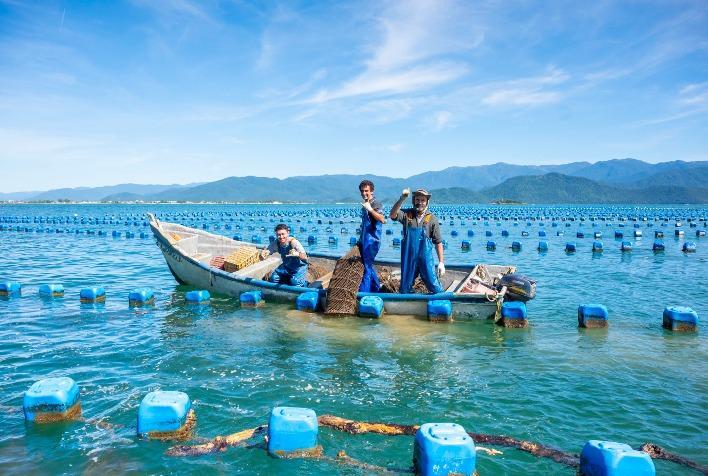
Today, farmed oysters are part of the coast’s landscape, food and travel experiences. In Florianópolis they connect science, work, the marine environment and food culture. An oyster does not need to have started in Santa Catarina to be part of the region’s identity today.
See it up close
In Ribeirão da Ilha, Ostra Xperience brings visitors into the world of oyster farming through a visit that combines knowledge, place and tasting. It is a chance to understand the road an oyster travels, from the water to the table.
Sources and references
- Epagri. The introduction of Crassostrea gigas in Brazil and the development of oyster farming in Santa Catarina (technical chapter). See the technical publication.
- Suplicy, Felipe Matarazzo (ed.). Manual do cultivo de ostras. Florianópolis: Epagri, 2022. Library record.
- Suplicy, F. M.; Souza, R. V. Farming Pacific oysters using the spat-on-shell system in a shallow area in the subtropical coast of Brazil. Ocean and Coastal Research, 2022. Read the scientific article.