
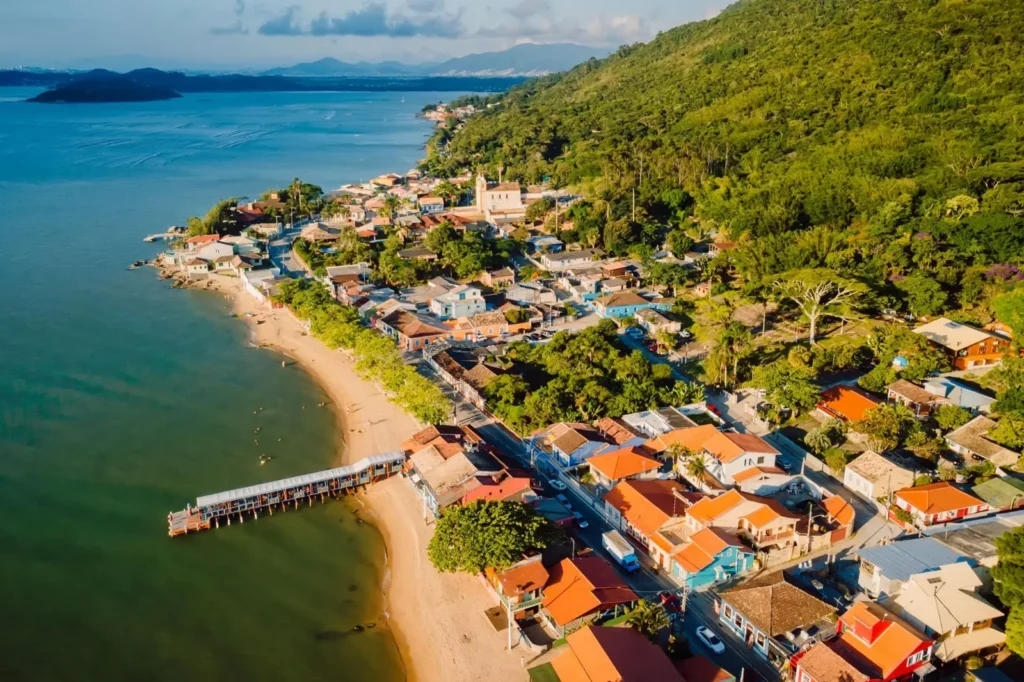
A place where the landscape tells stories
In the south of Santa Catarina Island, Ribeirão da Ilha preserves details that help explain how Florianópolis took shape, historically and culturally. The landscape brings together sea, old buildings, small lanes and an everyday life tied to the coast. For a visitor, it is a very different experience from the busier parts of the city.
Its value is more than beauty. The district has historical, cultural and tourism value, and it is among the oldest settled areas of the island. Azorean colonization shaped features that are still part of the local identity. [1]
Azorean heritage and life by the sea
Settlement here goes back to the first centuries of colonial history, and took on its distinctive character with the arrival of Azorean settlers in the 18th century. Over time, the community developed fishing, farming, trade and ways of using what the land and sea offered.
This bond with the environment shows in the built landscape, the traditions and how the area developed. Heritage is not only old buildings; it also includes cultural practices, memories and ways of life that explain a community.
To know Ribeirão is to see a part of Florianópolis outside the city center, and to see how coastal communities built their relationship with land and sea, one that continues in daily life.
How did oysters enter this story?
Oyster farming added a new layer to the district’s relationship with the sea. It is a supply chain that involves research, seed supply, farm management, monitoring and skilled work.
In Santa Catarina, commercial oyster farming was driven by technical and scientific efforts from the late 1980s, and the Florianópolis area became especially relevant for farmed oysters. Studies highlight the importance of the island’s bay for this activity and describe the techniques used. [2]
Today’s oyster farming does not replace older traditions; it adds to them. The work of the farmers, the food and the chance to welcome visitors create new ways to value the place and share its story.
Experience travel: beyond the postcard
You can visit a place by passing through its best-known spots. Experience travel is different: it is about meeting the people, the processes and the stories behind a destination. In Ribeirão da Ilha, that can mean walking the historic area, taking in the coastal scenery, seeing local production and finding out how the oyster gets to your table.
Food becomes a way into culture, environment, work and regional development. It also widens how a visitor sees a destination: instead of just a dish at a restaurant, you understand part of the supply chain and the work behind it.
The oyster as a link between place, knowledge and food
Valuing Santa Catarina oysters means recognizing how complex they are to produce. Farming takes technical knowledge and care for environmental and sanitary conditions, and the tasting is just one step in a story that starts long before the food reaches the table.
Once you understand that, the food experience means more. The landscape, the history of the place and the work of those who grow the oysters become part of your memory of the visit. That is what makes Ribeirão da Ilha such a special setting.
Discover Ribeirão da Ilha through oyster culture
Ostra Xperience invites visitors to get closer to oyster farming in Florianópolis, with a talk on the farming and an oyster tasting tied to the place. For groups, travel agents, institutions and anyone curious about local production, it is a way to explore Ribeirão da Ilha beyond the view, bringing together food, culture and knowledge.
Sources and references
- Florianópolis City Hall. Ribeirão da Ilha District Plan (location, historical settlement and cultural and tourism relevance). See the district plan.
- Suplicy, F. M.; Souza, R. V. Farming Pacific oysters using the spat-on-shell system in a shallow area in the subtropical coast of Brazil. Ocean and Coastal Research, 2022. Read the scientific article.
- Epagri. Manual do cultivo de ostras. Florianópolis: Epagri, 2022. Learn more about the manual.