
A food tied to coastal history
Around the world, a community’s relationship with the sea goes far beyond fishing. It shapes what people eat, how they work, their traditions and how they see themselves. Oysters have been part of that for centuries, and have played different roles depending on the region, local customs and farming techniques.
In France, oysters are deeply tied to the cuisine and identity of coastal towns. In Brazil, especially Santa Catarina, commercial farming is more recent, with research institutions, universities and farmers involved. The histories differ, but both show how a marine resource becomes a dish and a piece of cultural heritage.
Cancale: a French tradition by the sea
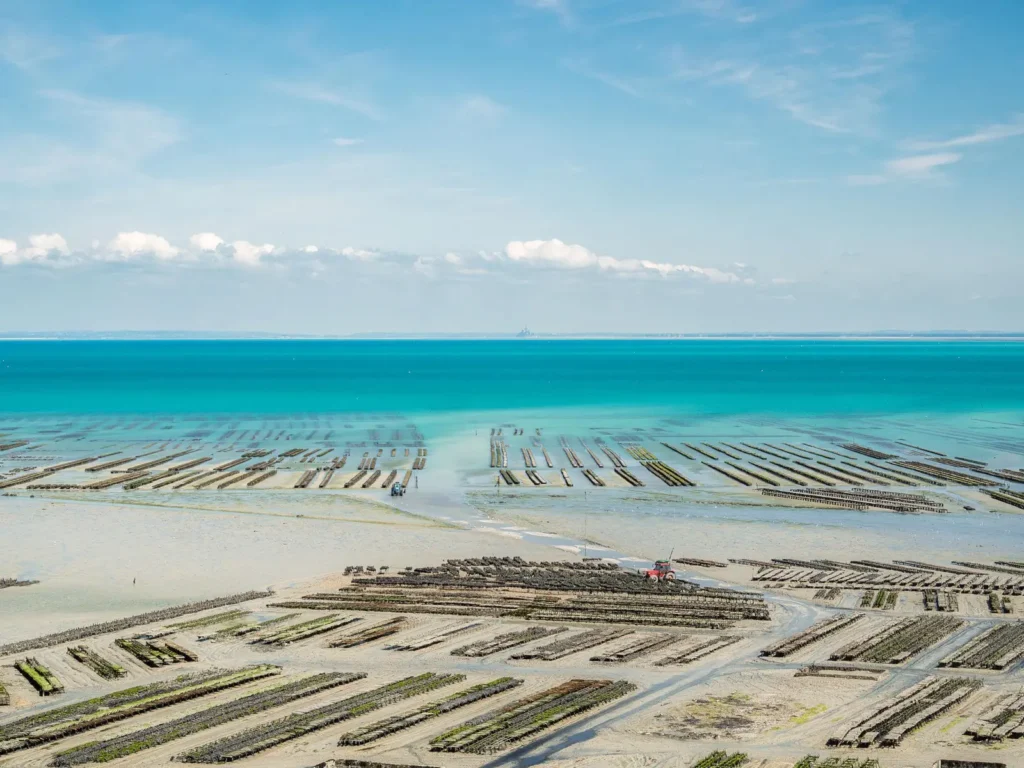
In Brittany, in northwestern France, the town of Cancale is known for its long history with oysters. According to the Cancale museum of popular arts and traditions, flat oysters were gathered from the sea and supplied French markets, including Paris. The trade built the town’s reputation for food.
The museum also records how farming methods improved over time: young oysters were placed in structures that protected them from predators and the sea, then moved to growing areas. The work needed constant upkeep and attention to the tides. Oyster farming was not born finished; it was built by the experience of generations. [1]
From craft to organized production
Cancale’s story shows something common to many coastal trades: you have to understand the environment and fit your work to natural cycles. Oyster growth, tides, predator protection and harvest organization shaped the techniques.
As farming improved, it combined traditional knowledge with technical methods. That did not remove the human work; it made mastering each stage and reading the sea even more important. The French example also shows how a food can become part of a travel destination. Where oysters are famous, the food draws visitors who want the flavor, the landscape, the history and a taste of local culture.
Santa Catarina: an identity built with the sea
On the Santa Catarina coast, oyster farming has its own path. The introduction of the Pacific oyster (Crassostrea gigas) and the research carried out from the late 1980s helped the industry take hold. Florianópolis Bay became a standout area for farmed oysters in Brazil. [2]
Production here combines research, seed supply, farm management and the work of the oyster farmers, tied to coastal communities and regional food. Even though the species comes from the Pacific, how the industry grew in Santa Catarina belongs to local history: technical knowledge, farming practices, the people involved and a bond with the place.
What do France and Santa Catarina share?
Both show that eating an oyster can mean much more than the plate. In Cancale, tradition, history and food tie the town to the shellfish. In Santa Catarina, today’s production connects to the land, research, coastal communities and tourism.
The models, species and histories are different, so this is not a claim that they are the same story. What they share is how oyster farming can bring food, knowledge and regional identity together.
An experience that starts before the table
Getting to know a place through its food shows how people live, work and relate to their environment. With oysters, that can include the coastal landscape, an explanation of the farming and a tasting of different preparations.
In Ribeirão da Ilha, in Florianópolis, Ostra Xperience offers exactly that mix of food, place and knowledge, a part of Santa Catarina culture that starts in the sea and ends at your table.
Sources and references
- Musée de Cancale. Ostréiculture. History of oyster fishing and farming in the French town. Read the museum publication.
- Suplicy, F. M.; Souza, R. V. Farming Pacific oysters using the spat-on-shell system in a shallow area in the subtropical coast of Brazil. Ocean and Coastal Research, 2022. Read the scientific article.
- Epagri. Manual do cultivo de ostras. Florianópolis: Epagri, 2022. See the manual.